
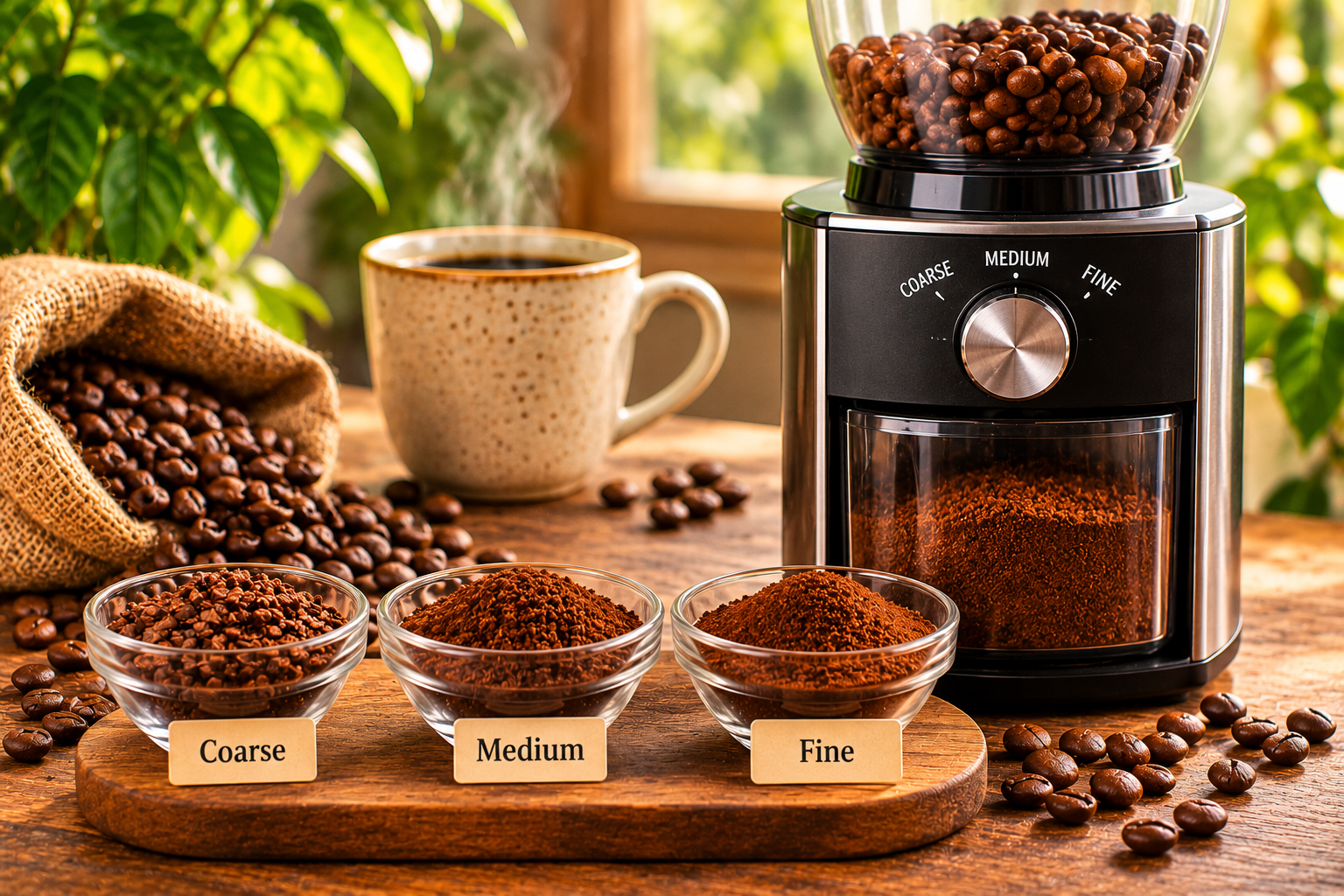
Why Grind Size Matters
Different brewing methods expose coffee to water in different ways. A general starting guide is:
- Extra Fine: Turkish-style coffee
- Fine: Espresso
- Medium-Fine: Many pour-over methods
- Medium: Most automatic drip coffee
- Medium-Coarse: Some larger-batch drip methods
- Coarse: French press and cold brew
These are starting ranges, not universal laws. Coffee, brewer design, dose and personal taste can all require adjustment.
Blade vs. Burr Grinders
Blade Grinder
A blade grinder chops coffee with a spinning blade. They are usually inexpensive and simple, but particle size can be uneven.
Burr Grinder
A burr grinder crushes coffee between two grinding surfaces. The distance between those surfaces determines the grind size.
Burr grinders generally offer more repeatable control over particle size, which is valuable when adjusting a coffee recipe.
Conical vs. Flat Burrs
Burr grinders may use conical or flat burrs. Both can produce excellent coffee.
The geometry of the burrs affects how beans move through the grinder and the particle distribution they produce.
For most home coffee drinkers, grind consistency, adjustment range, ease of use and whether the grinder suits the intended brew method matter more than simply choosing “flat” or “conical.”
Why Fresh Grinding Can Help
Grinding coffee dramatically increases its exposed surface area. That allows aromatic compounds to escape more quickly.
Grinding shortly before brewing can preserve more aroma compared with coffee that has been sitting ground for a long period.
Pre-ground coffee is still convenient and useful, but a grinder gives you more control.
What Does “Dialing In” Mean?
Dialing in simply means adjusting the grind until the coffee tastes the way you want.
If extraction seems too fast or the coffee tastes weak, a finer setting may help. If extraction is too slow or the coffee tastes harsh, a coarser setting may help.
The exact adjustment depends on the brewing method.
Do You Need an Expensive Grinder?
Not necessarily.
Someone brewing straightforward drip coffee may not need the same level of precision as someone making espresso.
Espresso is particularly sensitive to small grind changes, so an espresso-focused grinder generally needs much finer adjustment control.
For French press, drip and many pour-over methods, there are many simpler grinders capable of doing the job well.
Questions to Ask Before Choosing a Grinder
- What brewing methods will I use?
- Do I need espresso-fine adjustment?
- How much coffee do I grind at once?
- Do I want manual or electric operation?
- How important is noise?
- Is the grinder easy to clean?
- Can I adjust the grind precisely enough for my brewer?
Morning Warrior Takeaway
The best grinder is not automatically the most expensive one.
It is the grinder that gives you consistent grounds across the brewing methods you actually use.
Choose the brewer first, then choose a grinder capable of supporting it.
Continue Exploring
Morning Warrior Coffee may earn a commission when you buy through links to participating merchants — at no additional cost to you.